drawing a 3d model in autocad

This is a guest post by Andreea Georgiana. She is a CAD enthusiast who likes using the power of Calculator Aided Design to create cool useful designs, from formulation to 3D printing. She has a 21-day AutoCAD course at tutorial45.com.
She says, "Being able to utilise Figurer Aided Blueprint software to bring your ideas to life is one of the things I totally disagree only engineers should be able to do. With the numerous advantages of existence able to motion past the level of a 3D model to actually having the model 3D printed, anyone should consider learning at least the basics of modifying a CAD model.
"As a CAD hobbyist, wife and mother, I have found many cases where a customized solution designed myself has solved a problem in the exact manner I wanted, thanks to the power of CAD and 3D printing. You tin can find some gratuitous tutorials here."
* * * * *
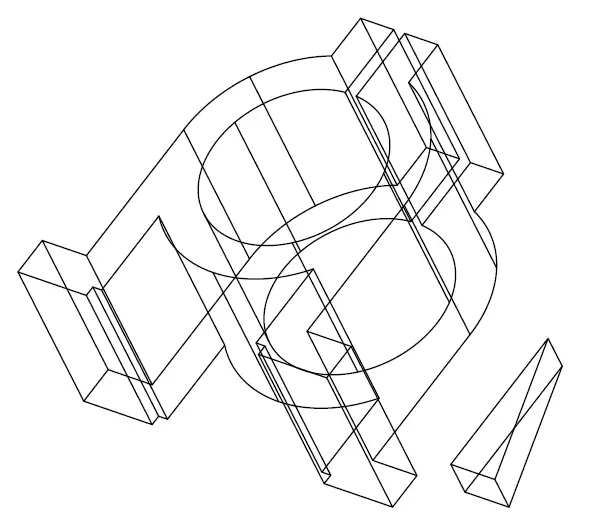
Before I offset, here are second and 3D images of the model you'll draw in this tutorial,
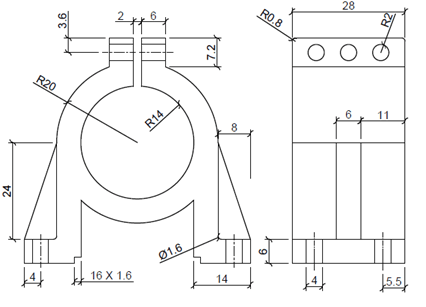
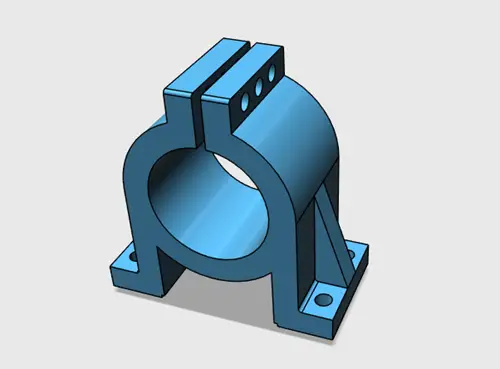
Use the images in a higher place to help you in completing the 3D model.
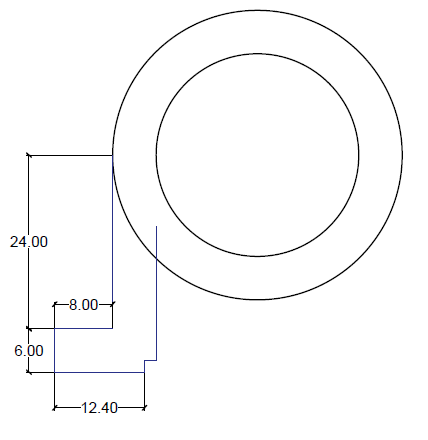
Stage one: Depict the piping (circles) and legs (lines)
Make sure the Quadrant and Midpoint in Objects SNAP settings are on. The upper parts of the legs are snapped to the left and correct quadrants of the model. Subsequently, yous'll apply the Midpoint OSNAP.
Then follow these steps, post-obit the image to the right and beneath:
- Draw 2 concentric circles with R20 and R14.
- Draw a vertical line down from the left quadrant of the outer circle 24 units long
- Draw a horizontal line of 8 units toward the left using the lower end of the vertical line you lot just drew as the starting bespeak.
- Draw a vertical line of half dozen units downward from the ending point of the previous line
- Draw a horizontal line of 12.4 units rightward from the ending point of the previous line
- Draw a vertical line of 1.half dozen units upward
- Draw a line of one.6 units to the right
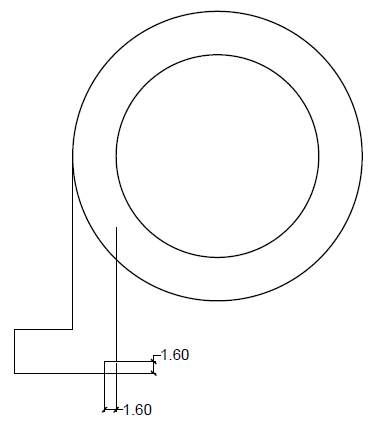

At present follow these steps to trim and mirror the model:
- Utilize the TRIM command to remove the unnecessary role of the circle. Use the 2 lines that encounter the circle as the cut edges and the part of the circle between them every bit the object to trim.
- Now mirror this left side using the center of the circumvolve to create the similar shape on the right side of the circle.
- Trim it to complete this step using the TRIM command. Y'all should cease up with an prototype similar to the ane below
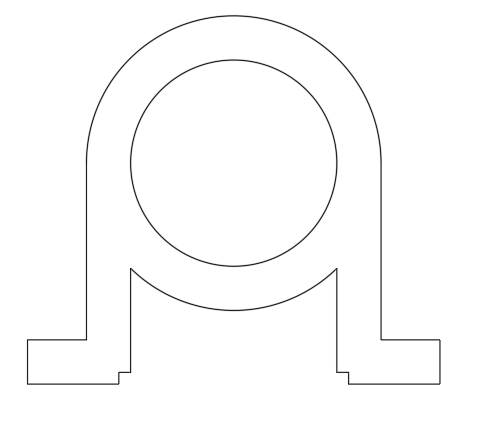
Stage ii: Pause the circles at the top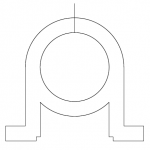
Follow these steps:
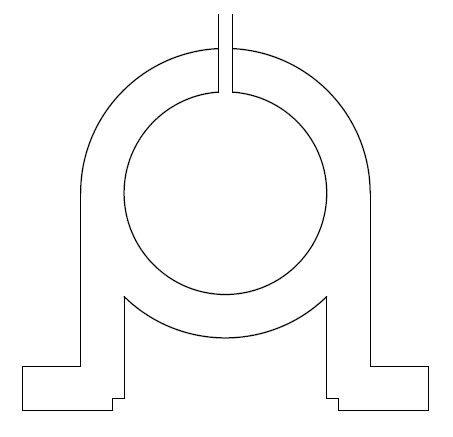
- Use the Upper quadrant of the inner circle to draw a vertical line that crosses the outer circle. The length of the line does non matter.
- Utilise the OFFSET command with the OFFSET dimension ready to 1 units to depict 2 lines on each side of the original line.
- At present delete the key line.
-
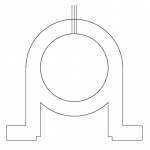 Use the EXTEND command to extend the remaining lines to the inner circle. You might need to zoom in to notice that they don't actually intersect with the circle.
 - Use the TRIM command to trim the two circles as shown in the image below. Use the lines every bit the cutting edges.
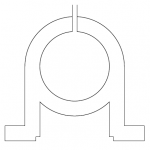
Phase 3: Add the pinnacle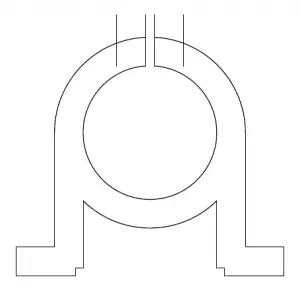
Follow these steps:
- Use the Commencement control to beginning the left line to the left and the right line to the correct with an offset distance of vi units.
- Trim the new outer lines using the outer circle as the cutting border., And then trim the peak part of the outer circumvolve using the outer lines as the cutting edge.
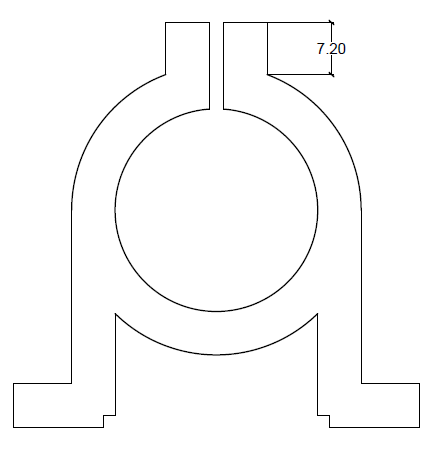
- You want the outer lines to exist 7.2 units long, as shown on the image below and and then and you demand to shut the head using a horizontal line.
- Ane style to do this is to beginning the LINE command, blazon from on the control line and set the offset to 7.2, moving your cursor up. The depict the LINE horizontally to the left until it intersects the outer vertical line on the left. Then trim the parts of the line that extend past the new horizontal line and trim the part of the horizontal line between the 2 inner vertical lines.
Phase 4: Add the bracing (triangle)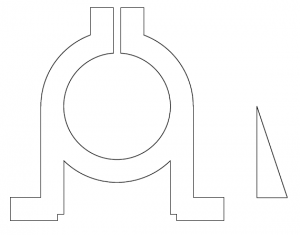
Design the little triangle on the side of the model by drawing a vertical line of 24 units, a horizontal line of 8 units, and and then closing the triangle. For now, put it out to the side, separated from the main model. You can describe on acme of the existing lines to start, close the triangle, and then select each of the 3 lines and move them to the right.
Phase 5: Fix for 3D conversion
Employ the REGION command and select everything on the drawing area to class ii regions.
At this point, if y'all aren't using a 3D workspace, y'all should switch to i. Click the piddling arrow to the right of the Workspace Switching icon on the lower-right corner of the AutoCAD window and choose 3D Modeling.
Phase 6: Alter the view and extrude to 3D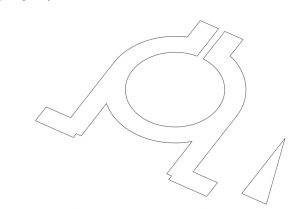
Navigate in 3D using Complimentary Orbit. Click on Gratuitous Orbit in the navigational bar at the right, click on your mouse, hold, and move until you get a 3D view something like the one you see here. Y'all can drag on the "orb" and its circular handles to go the right view. A keyboard shortcut might work for you lot: Hold down the Shift key and click and drag with your mouse's middle (scroll) button.
Use the EXTRUDE command to extrude the model by 28 units and the triangle by half-dozen units.
On the Visualize tab, in the Visual Styles panel, click the Visual Styles driblet-downwards and choose Shades of Grayness.
Stage 7: Assemble the model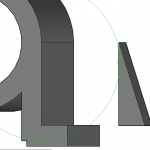
Follow these steps:
- Using the View cube at the upper right of the AutoCAD window, switch to the Top view (or go to the Visualize tab, Views panel, and click Tiptop.)
- Use a regular 2nd mirror command to mirror correct triangle so that y'all have 1 on each side of the 3D model.
- Now use 3D orbit again to become a view similar you see here.
-
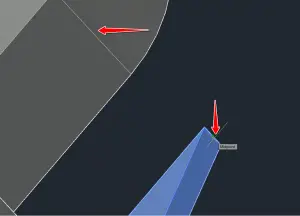
- Employ the MOVE control to move the triangle from the midpoint of its upper edge to the midpoint of the 3D line on the circle quadrant. as shown in the paradigm here.
- Turn the view again so y'all tin can run across the left side of the 3D model and move the left triangle in the same fashion.
- Commencement the UNION command, select the 3 objects, and press Enter.
You take just merged the 3 object to class one.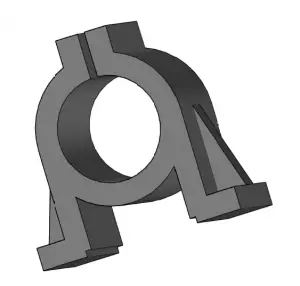
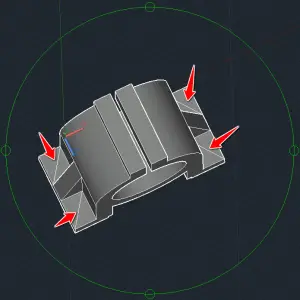 Stage 8: Add mounting holes to the base of operations
One nice affair with AutoCAD when y'all model in 3D is that you tin can still utilise the power OSNAP and draw 2D lines that will help you lot design in 3D.
Follow these steps:
- View the model so yous can create the diagonal lines shown on the paradigm at the correct. Apply the Endpoint OSNAP for the starting time and end points. Y'all'll have to change the view several times as you describe the lines.
- Create circles using the midpoint of each of the lines you only created every bit the middle and a radius of two.
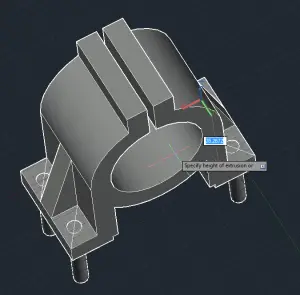
- Extrude the circles downward and so the height goes completely through the model. You tin can select and extrude them all at one time.
- Subtract the 4 cylinders from the model. Start the SUBTRACT control, select the model and press Enter, then select all of the cylinders and printing Enter.
- Delete the diagonal lines.
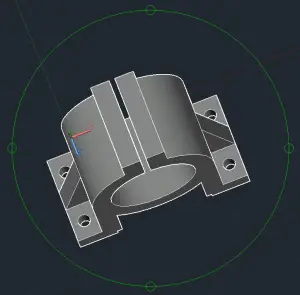
Phase ix: Fillet the precipitous corners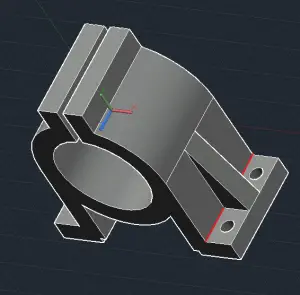
The FILLET command will help you round some of the sharp edges. Follow these steps:
- Select the edges with the red marking. To get in easier to select simply the edge, on the Home tab, in the Pick panel, choose Border from the Filter driblet down. (You lot might run across No Filter, Vertex or Face up before y'all brand this choice.)
- Utilise the FILLET command to round their shape with a dimension of R = 0.8 units. To FILLET, start the command, select the appropriate edge, enter 0.eight, and press ENTER two times.
- Repeat the process with the opposite edge.
Phase 10: Add together holes in the height
This is the concluding phase. Follow these steps:
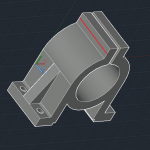
- Draw the line shown on the image below using the midpoints of the two edges.
- Create a circumvolve of radius 2 units using the middle of the drawn line.
- Delete the line you just drew and create ii lines using the quadrant of the circle and 2 edges y'all previously used. Yous might have to rotate the model to observe the object snaps.
- At present, utilise the center of those lines to create 2 circles of radius 2.
- Delete the lines and extrude the three circles using the EXTRUDE control and make certain they become all the way through the model.
- Decrease those cylinders from the 3D model using the Subtract command.
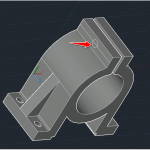
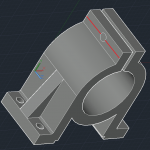
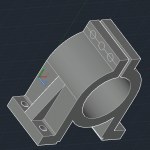
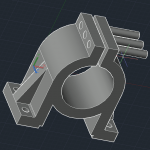
Congratulations!
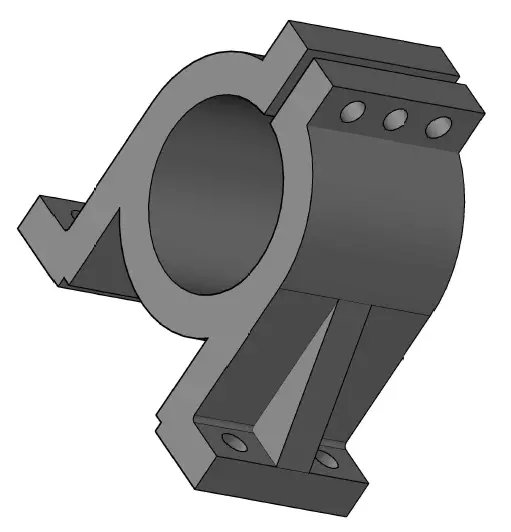
You lot should finish up with the following model. Yous might need to FILLET few more than edges to take your model look identical to the model on the exercise. I promise this has been helpful to you!
Andreea hasa 21-lesson course here that you might find valuable.
- Author
- Recent Posts

Ellen Finkelstein is the author of the best-selling AutoCAD & AutoCAD LT Bible, which started with R14. Ellen has written extensively on AutoCAD, including articles for Autodesk'southward website and features for AutoCAD'due south Help system. Ellen's starting time book was AutoCAD For Dummies Quick Reference.
Source: https://allaboutcad.com/tutorial-create-3d-model/
0 Response to "drawing a 3d model in autocad"
Post a Comment