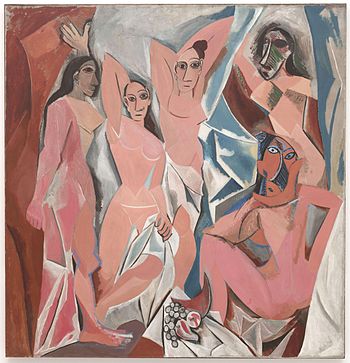
36 Pablo Picasso Les Demoiselles Dã¢ââ¢avignon 1907 Oil on Canvas Museum of Modern Art New York
| Les Demoiselles d'Avignon | |
|---|---|
| English: The Ladies of Avignon | |
 | |
| Artist | Pablo Picasso |
| Year | 1907 |
| Medium | Oil on canvas |
| Movement | Proto-Cubism |
| Dimensions | 243.ix cm × 233.vii cm (96 in × 92 in) |
| Location | Museum of Modernistic Art. Acquired through the Lillie P. Bliss Heritance, New York Urban center[1] |
Les Demoiselles d'Avignon ( The Young Ladies of Avignon , originally titled The Brothel of Avignon )[2] is a large oil painting created in 1907 by the Spanish artist Pablo Picasso. The work, office of the permanent drove of the Museum of Modern Art, portrays 5 nude female prostitutes in a brothel on Carrer d'Avinyó, a street in Barcelona, Spain. Each figure is depicted in a disconcerting confrontational manner and none is conventionally feminine. The women appear slightly menacing and are rendered with athwart and disjointed torso shapes. The figure on the left exhibits facial features and dress of Egyptian or southern Asian style. The two adjacent figures are shown in the Iberian way of Picasso's native Espana, while the two on the right are shown with African mask-similar features. The ethnic primitivism evoked in these masks, according to Picasso, moved him to "liberate an utterly original artistic style of compelling, even vicious forcefulness."[3] [4] [v]
In this adaptation of primitivism and abandonment of perspective in favor of a flat, 2-dimensional moving picture airplane, Picasso makes a radical departure from traditional European painting. This proto-cubist work is widely considered to be seminal in the early evolution of both cubism and modern fine art.
Les Demoiselles was revolutionary and controversial and led to widespread acrimony and disagreement, even amongst the painter'due south closest associates and friends. Matisse considered the work something of a bad joke all the same indirectly reacted to information technology in his 1908 Bathers with a Turtle. Georges Braque also initially disliked the painting yet peradventure more than anyone else, studied the piece of work in great detail. His subsequent friendship and collaboration with Picasso led to the cubist revolution.[six] [7] Its resemblance to Cézanne's The Bathers, Paul Gauguin's statue Oviri and El Greco's Opening of the 5th Seal has been widely discussed by later critics.
At the fourth dimension of its start exhibition in 1916, the painting was deemed immoral.[viii] The work, painted in Picasso's studio in the Bateau-Lavoir in Montmartre, Paris, was seen publicly for the starting time time at the Salon d'Antin in July 1916, at an exhibition organized by the poet André Salmon. It was at this exhibition that Salmon (who had previously titled the painting in 1912 Le bordel philosophique) renamed the work its current, less scandalous championship, Les Demoiselles d'Avignon, instead of the title originally chosen by Picasso, Le Bordel d'Avignon.[2] [half-dozen] [9] [10] Picasso, who always referred to information technology as mon bordel ("my brothel"),[eight] or Le Bordel d'Avignon,[9] never liked Salmon's championship and would accept instead preferred the bowdlerization Las chicas de Avignon ("The Girls of Avignon").[2]
Background and development [edit]

Picasso came into his own as an of import artist during the first decade of the 20th century. He arrived in Paris from Kingdom of spain around the turn of the century as a young, ambitious painter out to make a name for himself. For several years he alternated between living and working in Barcelona, Madrid and the Spanish countryside, and made frequent trips to Paris.
By 1904, he was fully settled in Paris and had established several studios, important relationships with both friends and colleagues. Betwixt 1901 and 1904, Picasso began to attain recognition for his Blue Menses paintings. In the primary these were studies of poverty and desperation based on scenes he had seen in Spain and Paris at the turn of the century. Subjects included gaunt families, bullheaded figures, and personal encounters; other paintings depicted his friends, but most reflected and expressed a sense of blueness and despair.[eleven]
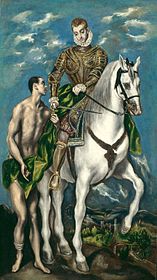

He followed his success past developing into his Rose Menstruum from 1904 to 1907, which introduced a strong element of sensuality and sexuality into his piece of work. The Rose period depictions of acrobats, circus performers and theatrical characters are rendered in warmer, brighter colors and are far more hopeful and joyful in their depictions of the bohemian life in the Parisian avant-garde and its environs. The Rose menses produced two of import large masterpieces: Family of Saltimbanques (1905), which recalls the work of Gustave Courbet (1819–1877) and Édouard Manet (1832–1883); and Boy Leading a Horse (1905–06), which recalls Cézanne's Bather (1885–1887) and El Greco's Saint Martin and the Beggar (1597–1599). While he already had a considerable following by the middle of 1906, Picasso enjoyed farther success with his paintings of massive oversized nude women, monumental sculptural figures that recalled the work of Paul Gauguin and showed his interest in archaic (African, Micronesian, Native American) art. He began exhibiting his piece of work in the galleries of Berthe Weill (1865–1951) and Ambroise Vollard (1866–1939), quickly gaining a growing reputation and a following amongst the artistic communities of Montmartre and Montparnasse.[11]
Picasso became a favorite of the American art collectors Gertrude Stein and her brother Leo effectually 1905. The Steins' older brother Michael and his married woman Sarah as well became collectors of his work. Picasso painted portraits of both Gertrude Stein and her nephew Allan Stein.[12]
Gertrude Stein began acquiring Picasso's drawings and paintings and exhibiting them in her breezy Salon at her home in Paris. At one of her gatherings in 1905 he met Henri Matisse (1869–1954), who was to get in those days his chief rival, although in later years a close friend. The Steins introduced Picasso to Claribel Cone (1864–1929), and her sister Etta Cone (1870–1949), also American fine art collectors, who began to acquire Picasso and Matisse'due south paintings. Eventually Leo Stein moved to Italy, and Michael and Sarah Stein became important patrons of Matisse, while Gertrude Stein continued to collect Picasso.[13]
Rivalry with Matisse [edit]

Henri Matisse, Le bonheur de vivre (1905–06), oil on canvas, 175 × 241 cm. Barnes Foundation, Merion, PA. A painting that was called Fauvist and brought Matisse both public derision and notoriety. Hilton Kramer wrote: "owing to its long sequestration in the collection of the Barnes Foundation, which never permitted its reproduction in color, it is the least familiar of modern masterpieces. Nonetheless this painting was Matisse's own response to the hostility his work had met with in the Salon d'Automne of 1905."[14]
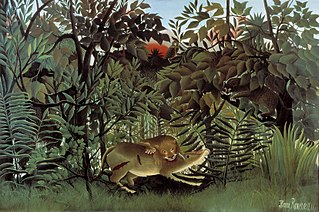
The Salon d'Automne of 1905 brought notoriety and attention to the works of Henri Matisse and the Les Fauves group. The latter gained their name after critic Louis Vauxcelles described their work with the phrase "Donatello chez les fauves" ("Donatello among the wild beasts"),[15] contrasting the paintings with a Renaissance-type sculpture that shared the room with them.[16] Henri Rousseau (1844–1910), an artist whom Picasso knew and admired and who was not a Fauve, had his big jungle scene The Hungry Lion Throws Itself on the Antelope too hanging near the works past Matisse and which may have had an influence on the particular sarcastic term used in the press.[17] Vauxcelles' annotate was printed on 17 October 1905 in the daily newspaper Gil Blas, and passed into popular usage.[xvi] [18]
Although the pictures were widely derided—"A pot of paint has been flung in the face of the public", alleged the critic Camille Mauclair (1872–1945)—they too attracted some favorable attention.[16] The painting that was singled out for the most attacks was Matisse's Woman with a Hat; the buy of this work by Gertrude and Leo Stein had a very positive effect on Matisse, who was suffering demoralization from the bad reception of his piece of work.[16]
Matisse's notoriety and preeminence as the leader of the new movement in mod painting connected to build throughout 1906 and 1907, and Matisse attracted a following of artists including Georges Braque (1880–1963), André Derain (1880–1954), Maurice de Vlaminck (1876–1958). Picasso's piece of work had passed through his Blue period and his Rose period and while he had a considerable following his reputation was tame in comparison to his rival Matisse. The larger theme of Matisse's influential Le bonheur de vivre, an exploration of "The Gilt Age", evokes the historic "Ages of Human being" theme and the potentials of a provocative new historic period that the twentieth century era offered. An equally bold, similarly themed painting titled The Golden Historic period, completed past Derain in 1905, shows the transfer of human ages in an even more direct mode.[nineteen]
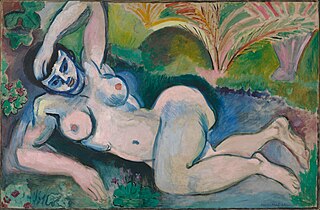
Matisse and Derain shocked the French public over again at the March 1907 Société des Artistes Indépendants when Matisse exhibited his painting Blue Nude and Derain contributed The Bathers. Both paintings evoke ideas of homo origins (world beginnings, evolution) an increasingly important theme in Paris at this time.[19] The Blue Nude was one of the paintings that would later create an international awareness at the Arsenal Show of 1913 in New York City.[xx]
From October 1906 when he began preparatory work for Les Demoiselles d'Avignon, until its completion in March 1907, Picasso was vying with Matisse to be perceived as the leader of Mod painting. Upon its completion the stupor and the impact of the painting propelled Picasso into the center of controversy and all but knocked Matisse and Fauvism off the map, almost ending the movement past the post-obit year. In 1907 Picasso joined the art gallery that had recently been opened in Paris by Daniel-Henry Kahnweiler (1884–1979). Kahnweiler was a German art historian and collector who became i of the premier French fine art dealers of the 20th century. He became prominent in Paris beginning in 1907 for existence amidst the beginning champions of Picasso, and especially his painting Les Demoiselles d'Avignon. Before 1910 Picasso was already being recognized as ane of the important leaders of Modern fine art aslope Henri Matisse, who had been the undisputed leader of Fauvism and who was more than 10 years older than he, and his contemporaries the Fauvist André Derain and the former Fauvist and fellow Cubist, Georges Braque.[21]
In his 1992 essay Reflections on Matisse, the art critic Hilton Kramer wrote,
Later on the bear on of Les Demoiselles d'Avignon, nonetheless, Matisse was never once again mistaken for an advanced incendiary. With the bizarre painting that appalled and electrified the cognoscenti, which understood the Les Demoiselles was at in one case a response to Matisse's Le bonheur de vivre (1905–1906) and an assault upon the tradition from which it derived, Picasso effectively appropriated the role of avant-garde wild beast—a office that, as far every bit public opinion was concerned, he was never to relinquish.[22]
Kramer goes on to say,
Whereas Matisse had fatigued upon a long tradition of European painting—from Giorgione, Poussin, and Watteau to Ingres, Cézanne, and Gauguin—to create a modernistic version of a pastoral paradise in Le bonheur de vivre, Picasso had turned to an alien tradition of primitive art to create in Les Demoiselles a netherworld of strange gods and violent emotions. Equally between the mythological nymphs of Le bonheur de vivre and the grotesque effigies of Les Demoiselles, there was no question as to which was the more shocking or more intended to be shocking. Picasso had unleashed a vein of feeling that was to have immense consequences for the art and civilisation of the modern era while Matisse'south ambition came to seem, equally he said in his Notes of a Painter, more express—express that is, to the realm of aesthetic pleasure. There was thus opened upwards, in the very beginning decade of the century and in the piece of work of its two greatest artists, the chasm that has continued to divide the art of the modernistic era down to our own time.[23]
Influences [edit]
Picasso created hundreds of sketches and studies in preparation for the final work.[ix] [24] He long best-selling the importance of Spanish art and Iberian sculpture as influences on the painting. The work is believed by critics to be influenced by African tribal masks and the art of Oceania, although Picasso denied the connection; many art historians remain skeptical almost his denials. Picasso spent an October 1906 evening closely studying a Teke figure from Congo then owned past Matisse. It was later that night that Picasso'south first studies for what would become Les Demoiselles d'Avignon were created.[19] Several experts maintain that, at the very least, Picasso visited the Musée d'Ethnographie du Trocadéro (known later as the Musée de l'Homme) in the bound of 1907 where he saw and sought inspiration from African and other arts shortly before completing Les Demoiselles. [25] [26] He had come to this museum originally to study plaster casts of medieval sculptures, and then also considered examples of "primitive" art.[nineteen]
El Greco [edit]


Pablo Picasso, Nus (Nudes), 1905, graphite on newspaper
El Greco's paintings, such as this Apocalyptic Vision of Saint John, have been suggested as a source of inspiration for Picasso leading upward to Les Demoiselles d' Avignon.[11]
In 1907, when Picasso began work on Les Demoiselles, one of the old master painters he greatly admired was El Greco (1541–1614), who at the time was largely obscure and under-appreciated. Picasso's friend Ignacio Zuloaga (1870–1945) acquired El Greco'due south masterpiece, the Opening of the Fifth Seal, in 1897 for g pesetas.[27] [28] The relation between Les Demoiselles d'Avignon and the Opening of the Fifth Seal was pinpointed in the early 1980s, when the stylistic similarities and the relationship betwixt the motifs and visually identifying qualities of both works were analyzed.[29] [30]
El Greco's painting, which Picasso studied repeatedly in Zuloaga's house, inspired not only the size, format, and composition of Les Demoiselles d'Avignon, merely besides its apocalyptic ability.[31] Afterwards, speaking of the piece of work to Dor de la Souchère in Antibes, Picasso said: "In whatever case, only the execution counts. From this point of view, information technology is correct to say that Cubism has a Castilian origin and that I invented Cubism. We must look for the Spanish influence in Cézanne. Things themselves necessitate it, the influence of El Greco, a Venetian painter, on him. Simply his construction is Cubist."[32]
The relationship of the painting to other group portraits in the Western tradition, such as Diana and Callisto past Titian (1488–1576), and the same subject by Rubens (1577–1640), in the Prado, has also been discussed.[33]
Cézanne and Cubism [edit]

Both Paul Gauguin (1848–1903) and Paul Cézanne (1839–1906) were accorded major posthumous retrospective exhibitions at the Salon d'Automne in Paris between 1903 and 1907, and both were important influences on Picasso and instrumental to his cosmos of Les Demoiselles. According to the English fine art historian, collector and author of The Cubist Epoch, Douglas Cooper, both of those artists were particularly influential to the germination of Cubism and especially important to the paintings of Picasso during 1906 and 1907.[34] Cooper goes on to say however Les Demoiselles is often erroneously referred to equally the offset Cubist painting. He explains,
The Demoiselles is generally referred to as the starting time Cubist picture. This is an exaggeration, for although it was a major showtime step towards Cubism it is not yet Cubist. The disruptive, expressionist chemical element in it is fifty-fifty reverse to the spirit of Cubism, which looked at the globe in a detached, realistic spirit. Nevertheless, the Demoiselles is the logical film to take as the starting betoken for Cubism, considering information technology marks the nativity of a new pictorial idiom, because in it Picasso violently overturned established conventions and considering all that followed grew out of it.[35]
Although not well known to the general public prior to 1906, Cézanne's reputation was highly regarded in advanced circles, as evidenced by Ambroise Vollard'southward interest in showing and collecting his work, and past Leo Stein'south interest. Picasso was familiar with much of Cézanne's work that he saw at Vollard'southward gallery and at the Stein's. After Cézanne died in 1906, his paintings were exhibited in Paris in a big calibration museum-like retrospective in September 1907. The 1907 Cézanne retrospective at the Salon d'Automne profoundly impacted the management that the advanced in Paris took, lending credence to his position as one of the most influential artists of the 19th century and to the advent of Cubism. The 1907 Cézanne exhibition was enormously influential in establishing Cézanne every bit an of import painter whose ideas were particularly resonant particularly to immature artists in Paris.[11] [36]
Both Picasso and Braque constitute the inspiration for their proto-Cubist works in Paul Cézanne, who said to detect and acquire to see and treat nature equally if it were equanimous of basic shapes like cubes, spheres, cylinders, and cones. Cézanne'due south explorations of geometric simplification and optical phenomena inspired Picasso, Braque, Metzinger, Gleizes, Robert Delaunay, Le Fauconnier, Gris and others to experiment with ever more complex multiple views of the aforementioned subject, and, eventually to the fracturing of grade. Cézanne thus sparked 1 of the most revolutionary areas of artistic enquiry of the 20th century, one which was to affect greatly the development of modern art.[36]
Gauguin and Primitivism [edit]


Gauguin, 1894, Oviri (Sauvage), partially glazed stoneware, 75 × 19 × 27 cm, Musée d'Orsay, Paris
Pablo Picasso's paintings of awe-inspiring figures from 1906 were straight influenced by Gauguin. The vicious ability evoked past Gauguin's work led directly to Les Demoiselles in 1907.[37]
During the tardily 19th and early 20th centuries, the European cultural elite were discovering African, Oceanic and Native American art. Artists such as Paul Gauguin, Henri Matisse and Picasso were intrigued and inspired by the stark power and simplicity of styles of those cultures. Around 1906, Picasso, Matisse, Derain and other artists in Paris had acquired an interest in primitivism, Iberian sculpture,[38] African art and tribal masks, in part because of the compelling works of Paul Gauguin that had suddenly achieved middle phase in the avant-garde circles of Paris. Gauguin's powerful posthumous retrospective exhibitions at the Salon d'Automne in Paris in 1903[39] and an even larger one in 1906[forty] had a stunning and powerful influence on Picasso'southward paintings.[11]
In the autumn of 1906, Picasso followed his previous successes with paintings of oversized nude women, and monumental sculptural figures that recalled the work of Paul Gauguin and showed his interest in archaic art. Pablo Picasso's paintings of massive figures from 1906 were directly influenced by Gauguin's sculpture, painting and his writing as well. The savage ability evoked by Gauguin's work lead directly to Les Demoiselles in 1907.[11]
According to Gauguin biographer David Sweetman, Pablo Picasso as early as 1902 became an aficionado of Gauguin's work when he met and befriended the expatriate Spanish sculptor and ceramist Paco Durrio, in Paris. Durrio had several of Gauguin'southward works on paw because he was a friend of Gauguin's and an unpaid amanuensis of his work. Durrio tried to help his poverty-stricken friend in Tahiti by promoting his oeuvre in Paris. Later they met Durrio introduced Picasso to Gauguin'due south stoneware, helped Picasso make some ceramic pieces and gave Picasso a first La Plumage edition of Noa Noa: The Tahiti Journal of Paul Gauguin. [41]
Concerning Gauguin's touch on on Picasso, art historian John Richardson wrote,
The 1906 exhibition of Gauguin's piece of work left Picasso more than ever in this artist'south thrall. Gauguin demonstrated the near disparate types of art—not to speak of elements from metaphysics, ethnology, symbolism, the Bible, classical myths, and much else besides—could be combined into a synthesis that was of its fourth dimension withal timeless. An artist could too confound conventional notions of beauty, he demonstrated, by harnessing his demons to the dark gods (non necessarily Tahitian ones) and borer a new source of divine free energy. If in later years Picasso played downwards his debt to Gauguin, in that location is no doubtfulness that between 1905 and 1907 he felt a very shut kinship with this other Paul, who prided himself on Castilian genes inherited from his Peruvian grandmother. Had not Picasso signed himself 'Paul' in Gauguin's honor.[42]
Both David Sweetman and John Richardson point to Gauguin's Oviri (literally meaning 'savage'), a gruesome phallic representation of the Tahitian goddess of life and death intended for Gauguin's grave. First exhibited in the 1906 retrospective, information technology was likely a straight influence on Les Demoiselles. Sweetman writes,
Gauguin'southward statue Oviri, which was prominently displayed in 1906, was to stimulate Picasso'south interest in both sculpture and ceramics, while the woodcuts would reinforce his interest in print-making, though it was the chemical element of the primitive in all of them which most conditioned the direction that Picasso's art would accept. This interest would culminate in the seminal Les Demoiselles d'Avignon.[43]
Co-ordinate to Richardson,
Picasso'due south interest in stoneware was further stimulated by the examples he saw at the 1906 Gauguin retrospective at the Salon d'Automne. The most agonizing of those ceramics (one that Picasso might have already seen at Vollard's) was the gruesome Oviri. Until 1987, when the Musée d'Orsay acquired this piffling-known work (exhibited but once since 1906) it had never been recognized equally the masterpiece information technology is, let alone recognized for its relevance to the works leading up to the Demoiselles. Although just nether xxx inches high, Oviri has an awesome presence, as befits a monument intended for Gauguin's grave. Picasso was very struck past Oviri. 50 years subsequently he was delighted when [Douglas] Cooper and I told him that we had come upon this sculpture in a collection that too included the original plaster of his Cubist head. Has it been a revelation, similar Iberian sculpture? Picasso'due south shrug was grudgingly affirmative. He was always loath to admit Gauguin'southward role in setting him on the route to primitivism.[44]
African and Iberian art [edit]

Female musician from the "Relief of Osuna", Iberian, ca. 200 BC

Iberian female sculpture from 3rd or 2d century BC
This style influenced Les Demoiselles d'Avignon.
During the 19th and 20th centuries, Europe's colonization of Africa led to many economic, social, political, and fifty-fifty artistic encounters. From these encounters, Western visual artists became increasingly interested in the unique forms of African art, particularly masks from the Niger-Congo region. In an essay by Dennis Duerden, author of African Art (1968), The Invisible Present (1972), and a one-time managing director of the BBC World Service, the mask is divers every bit "very often a complete head-apparel and not merely that office that conceals the face".[45] This form of visual art and image appealed to Western visual artists, leading to what Duerden calls the "discovery" of African fine art by Western practitioners, including Picasso.

African Fang mask similar in fashion to those Picasso saw in Paris just prior to painting Les Demoiselles d'Avignon
The stylistic sources for the heads of the women and their degree of influence has been much discussed and debated, in item the influence of African tribal masks, art of Oceania,[46] and pre-Roman Iberian sculptures. The rounded contours of the features of the iii women to the left can be related to Iberian sculpture, just non evidently the fragmented planes of the 2 on the right, which indeed seem influenced past African masks.[47] Lawrence Weschler says that,
in many ways, much of the moldering cultural and even scientific ferment that characterized the first decade and a half of the twentieth century and that laid the foundations for much of what we today consider modernistic can be traced dorsum to means in which Europe was already wrestling with its bad-faith, often strenuously repressed, knowledge of what it had been doing in Africa. The example of Picasso virtually launching cubism with his 1907 Desmoiselles d'Avignon, in response to the sorts of African masks and other colonial booty he was encountering in Paris'south Musee de l'Homme, is obvious.[5]

Congo masks published by Leo Frobenius in his 1898 volume Die Masken und Geheimbunde Afrika
Private collections and illustrated books featuring African art in this period were also important. While Picasso emphatically denied the influence of African masks on the painting: "African art? Never heard of it!" (L'art nègre? Connais pas!),[9] [48] this is belied by his deep involvement in the African sculptures owned past Matisse and his close friend Guiliaume Apollinaire.[nineteen] Since none of the African masks in one case thought to have influenced Picasso in this painting were available in Paris at the fourth dimension piece of work was painted, he is idea now to have studied African mask forms in an illustrated book by anthropologist Leo Frobenius.[19] Primitivism continues in his piece of work during, before and after the painting of Les Demoiselles d'Avignon, from spring 1906 through the jump of 1907. Influences from ancient Iberian sculpture are also of import.[11] [49] Some Iberian reliefs from Osuna, then just recently excavated, were on display in the Louvre from 1904. Archaic Greek sculpture has also been claimed as an influence.
The influence of African sculpture became an issue in 1939, when Alfred Barr claimed that the primitivism of the Demoiselles derived from the fine art of Côte d'Ivoire and the French Congo.[fifty] Picasso insisted that the editor of his catalogue raissonne, Christian Zervos, publish a disclaimer: the Demoiselles, he said, owed nothing to African art, everything to the reliefs from Osuna that he had seen in the Louvre a year or so earlier.[51] Notwithstanding, he is known to have seen African tribal masks while working on the painting, during a visit to the Ethnographic Museum of the Trocadero with Andre Malraux in March 1907, about which he afterwards said "When I went to the Trocadero, it was disgusting. The flea market, the smell. I was all lonely. I wanted to get away, just I didn't leave. I stayed, I stayed. I understood that it was very of import. Something was happening to me, right. The masks weren't like whatever other pieces of sculpture, not at all. They were magic things."[9] [52] [53] Maurice de Vlaminck is oftentimes credited with introducing Picasso to African sculpture of Fang extraction in 1904.[54]
Picasso biographer John Richardson recounts in A Life of Picasso, The Cubist Rebel 1907–1916, art dealer Daniel-Henry Kahnweiler'southward recollection of his outset visit to Picasso's studio in July 1907. Kahnweiler remembers seeing "dusty stacks of canvases" in Picasso's studio and "African sculptures of imperial severity". Richardson comments: "and then much for Picasso'south story that he was not yet enlightened of Tribal art.'"[55] A photograph of Picasso in his studio surrounded by African sculptures c.1908, is institute on page 27 of that aforementioned book.[56]
Suzanne Preston Blier says that, like Gauguin and several other artists in this era, Picasso used illustrated books for many of his preliminary studies for this painting. In addition to the Frobenius book, his sources included a 1906 publication of a twelfth-century Medieval art manuscript on architectural sculpture by Villiard de Honnecourt and a book by Carl Heinrich Stratz of pseudo-pornography showing photos and drawings of women from effectually the world organized to evoke ideas of human origins and evolution. Blier suggests that this helps account for the diversity of styles Picasso employed in his image-filled sketchbooks for this painting. These books, and other sources such as cartoons, Blier writes, also offering hints every bit to the larger significant of this painting.[19]
Mathematics [edit]
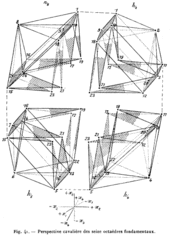
An analogy from Jouffret'due south Traité élémentaire de géométrie à quatre dimensions. The book, which influenced Picasso, was given to him past Princet.
Maurice Princet,[57] a French mathematician and actuary, played a role in the birth of Cubism as an acquaintance of Pablo Picasso, Guillaume Apollinaire, Max Jacob, Jean Metzinger, Robert Delaunay, Juan Gris and later Marcel Duchamp. Princet became known as "le mathématicien du cubisme" ("the mathematician of cubism").[58] [59]
Princet is credited with introducing the work of Henri Poincaré and the concept of the "fourth dimension" to artists at the Bateau-Lavoir.[60] Princet brought to the attention of Picasso, Metzinger and others, a volume past Esprit Jouffret, Traité élémentaire de géométrie à quatre dimensions (Simple Treatise on the Geometry of 4 Dimensions, 1903),[61] a popularization of Poincaré'due south Scientific discipline and Hypothesis in which Jouffret described hypercubes and other complex polyhedra in iv dimensions and projected them onto the two-dimensional surface. Picasso's sketchbooks for Les Demoiselles d'Avignon illustrate Jouffret's influence on the artist'southward work.[62]
Affect [edit]
Although Les Demoiselles had an enormous and profound influence on modern fine art, its impact was not firsthand, and the painting stayed in Picasso'due south studio for many years. At first, only Picasso'due south intimate circle of artists, dealers, collectors and friends were aware of the work. Soon afterwards the late summer of 1907, Picasso and his long-time lover Fernande Olivier (1881–1966) had a departing of the ways. The re-painting of the two heads on the far correct of Les Demoiselles fueled speculation that information technology was an indication of the split between Picasso and Olivier. Although they later on reunited for a period, the relationship concluded in 1912.[63]
A photo of the Les Demoiselles was first published in an article by Gelett Burgess entitled "The Wild Men of Paris, Matisse, Picasso and Les Fauves", The Architectural Tape, May 1910.[64]
Les Demoiselles would not be exhibited until 1916, and not widely recognized as a revolutionary accomplishment until the early on 1920s, when André Breton (1896–1966) published the work.[24] The painting was reproduced once again in Cahiers d'fine art (1927), within an commodity defended to African art.[65]
Richardson goes on to say that Matisse was fighting mad upon seeing the Demoiselles at Picasso's studio. He let it be known that he regarded the painting as an endeavor to ridicule the modern motility; he was outraged to detect his sensational Blue Nude, not to speak of Bonheur de vivre, overtaken by Picasso'south "hideous" whores. He vowed to go fifty-fifty and brand Picasso beg for mercy. Just as the Bonheur de vivre had fueled Picasso'south competitiveness, Les Demoiselles now fueled Matisse's.[66]
Among Picasso's airtight circle of friends and colleagues there was a mixture of opinions about Les Demoiselles. Georges Braque and André Derain were both initially troubled by it although they were supportive of Picasso. According to William Rubin, two of Picasso's friends, the art critic André Salmon and the painter Ardengo Soffici (1879–1964), were enthusiastic about it while Guillaume Apollinaire (1880–1918) wasn't. Both the art dealer-collector Wilhelm Uhde (1874–1947), and Kahnweiler were more enthusiastic almost the painting nevertheless.[67]
According to Kahnweiler Les Demoiselles was the beginning of Cubism. He writes:
Early in 1907 Picasso began a strange large painting depicting women, fruit and drapery, which he left unfinished. Information technology cannot exist called other than unfinished, fifty-fifty though it represents a long menstruum of piece of work. Begun in the spirit of the works of 1906, it contains in one section the endeavors of 1907 and thus never constitutes a unified whole.
The nudes, with large, quiet eyes, stand rigid, like mannequins. Their strong, round bodies are flesh-colored, blackness and white. That is the style of 1906.
In the foreground, however, alien to the mode of the rest of the painting, appear a crouching figure and a bowl of fruit. These forms are drawn angularly, not roundly modeled in chiaroscuro. The colors are luscious blue, strident yellow, adjacent to pure black and white. This is the offset of Cubism, the first upsurge, a desperate titanic clash with all of the bug at once.
—Kahnweiler, 1920[68]
Public view and championship [edit]
From sixteen to 31 July 1916 Les Demoiselles was exhibited to the public for the beginning time at the Salon d'Antin, an exhibition organized by André Salmon titled L'Fine art moderne en France. The exhibition space at 26 rue d'Antin was lent by the famous couturier and fine art collector Paul Poiret. The larger Salon d'Automne and Salon des Indépendants had been closed due to Earth War I, making this the merely Cubists' exhibition in France since 1914.[69] On 23 July 1916 a review was published in Le Cri de Paris:[70]
The Cubists are not waiting for the war to end to recommence hostilities against good sense. They are exhibiting at the Galerie Poiret naked women whose scattered parts are represented in all 4 corners of the canvas: here an eye, there an ear, over there a hand, a pes on top, a mouth below. One thousand. Picasso, their leader, is possibly the to the lowest degree disheveled of the lot. He has painted, or rather daubed, 5 women who are, if the truth exist told, all hacked up, and however their limbs somehow manage to hold together. They accept, moreover, piggish faces with eyes wandering negligently above their ears. An enthusiastic art-lover offered the artist 20,000 francs for this masterpiece. M. Picasso wanted more. The art-lover did not insist.[69] [seventy]
Picasso referred to his just entry at the Salon d'Antin every bit his Brothel painting calling information technology Le Bordel d'Avignon just André Salmon who had originally labeled the work, Le Bordel Philosophique, retitled information technology Les Demoiselles d'Avignon so every bit to lessen its scandalous impact on the public. Picasso never liked the title, however, preferring "las chicas de Avignon", simply Salmon's championship stuck.[two] Leo Steinberg labels his essays on the painting later on its original title. According to Suzanne Preston Blier, the give-and-take bordel in the painting'due south title, rather than evoking a business firm of prostitution (une maison close) instead more accurately references in French a complex situation or mess, This painting, Blier says, explores not prostitution per se, but instead sex and motherhood more more often than not, along with the complexities of development in the colonial multi-racial world. The name Avignon, scholars contend,[ who? ] not only references the street where Picasso once bought his paint supplies (which had a few brothels), simply too the abode of Max Jacob's grandmother, whom Picasso jocularly identifies as 1 of the painting'due south diverse modernistic day subjects.[nineteen]
The only other fourth dimension the painting might take been exhibited to the public prior to a 1937 showing in New York was in 1918, in an exhibition dedicated to Picasso and Matisse at Galerie Paul Guillaume in Paris, though very little information exists most this exhibition or the presence (if at all) of Les Demoiselles.[69]
Afterwards, the painting was rolled upwards and remained with Picasso until 1924 when, with urging and assistance from Breton and Louis Aragon (1897–1982), he sold it to designer Jacques Doucet (1853–1929), for 25,000 francs.[71] [72]
Interpretation [edit]

Pablo Picasso, Head of a Sleeping Woman (Study for Nude with Curtain), 1907, oil on sheet, 61.4 × 47.half-dozen cm, The Museum of Modern Art, New York
Picasso drew each of the figures in Les Demoiselles differently. The woman pulling the mantle on the upper correct is rendered with heavy paint. Composed of sharp geometric shapes, her head is the nearly strictly Cubist of all five.[73] The curtain seems to blend partially into her body. The Cubist caput of the crouching figure (lower correct) underwent at least two revisions from an Iberian figure to its current country. She likewise seems to have been drawn from 2 dissimilar perspectives at once, creating a confusing, twisted figure. The adult female above her is rather manly, with a dark confront and square breast. The whole movie is in a 2-dimensional mode, with an abandoned perspective.

Pablo Picasso, Les Demoiselles d'Avignon, item of the figure to the upper correct

Pablo Picasso, Les Demoiselles d'Avignon, detail of the figure to the lower right

Pablo Picasso, Nu aux bras levés (Nude), 1907
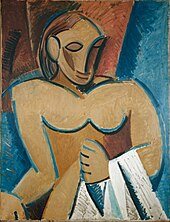
Pablo Picasso, 1907, Nu à la serviette, oil on canvas, 116 x 89 cm

Pablo Picasso, 1907, Femme nue, oil on canvas, 92 ten 43 cm, Museo delle Culture, Milano
Much of the disquisitional debate that has taken identify over the years centers on attempting to business relationship for this multiplicity of styles within the work. The dominant understanding for over v decades, espoused most notably by Alfred Barr, the first manager of the Museum of Mod Art in New York City and organizer of major career retrospectives for the artist, has been that information technology can be interpreted as testify of a transitional catamenia in Picasso's art, an effort to connect his earlier piece of work to Cubism, the style he would aid invent and develop over the adjacent five or half-dozen years.[i] Suzanne Preston Blier says that the divergent styles of the painting were added intentionally to convey to each women art "fashion" attributes from the five geographic areas each woman represents.[nineteen]
Art critic John Berger, in his controversial 1965 biography The Success and Failure of Picasso,[74] interprets Les Demoiselles d'Avignon as the provocation that led to Cubism:
Blunted by the insolence of and then much recent art, we probably tend to underestimate the brutality of the Les Demoiselles d'Avignon. All his friends who saw information technology in his studio were at first shocked by it. And it was meant to shock…
A brothel may not in itself be shocking. But women painted without charm or sadness, without irony or social comment, women painted similar the palings of a stockade through eyes that look out as if at death – that is shocking. And equally the method of painting. Picasso himself has said that he was influenced at the time by archaic Castilian (Iberian) sculpture. He was as well influenced – peculiarly in the two heads at the right – by African masks…here it seems that Picasso's quotations are simple, direct, and emotional. He is not in the least concerned with formal bug. The dislocations in this picture are the outcome of aggression, not aesthetics; it is the nearest yous can get in a painting to an outrage…
I emphasize the violent and iconoclastic attribute of this painting because information technology is usually enshrined as the bully formal practise which was the starting point of Cubism. It was the starting point of Cubism, in so far as it prompted Braque to begin painting at the end of the year his own far more formal reply to Les Demoiselles d'Avignon…withal if he had been left to himself, this film would never have led Picasso to Cubism or to any way of painting remotely resembling it…Information technology has nada to do with that twentieth-century vision of the future which was the essence of Cubism.
All the same it did provoke the first of the keen flow of exception in Picasso's life. Nobody tin know exactly how the alter began inside Picasso. We can just annotation the results. Les Demoiselles d'Avignon, dissimilar any previous painting by Picasso, offers no testify of skill. On the contrary, it is clumsy, overworked, unfinished. Information technology is as though his fury in painting information technology was so groovy that information technology destroyed his gifts…
Past painting Les Demoiselles d'Avignon Picasso provoked Cubism. Information technology was the spontaneous and, equally e'er, primitive insurrection out of which, for skilful historical reasons, the revolution of Cubism developed.[74]
In 1972, art critic Leo Steinberg in his essay The Philosophical Brothel posited a wholly different explanation for the wide range of stylistic attributes. Using the earlier sketches—which had been ignored past near critics—he argued that far from evidence of an creative person undergoing a rapid stylistic metamorphosis, the diverseness of styles can be read every bit a deliberate attempt, a careful plan, to capture the gaze of the viewer. He notes that the five women all seem eerily asunder, indeed wholly unaware of each other. Rather, they focus solely on the viewer, their divergent styles only furthering the intensity of their glare.[one]
The earliest sketches characteristic two men inside the brothel; a crewman and a medical pupil (who was oft depicted holding either a book or a skull, causing Barr and others to read the painting as a memento mori, a reminder of death). A trace of their presence at a table in the center remains: the bulging border of a table most the bottom of the canvas. The viewer, Steinberg says, has come to replace the sitting men, forced to confront the gaze of prostitutes head on, invoking readings far more complex than a simple allegory or the autobiographical reading that attempts to sympathize the work in relation to Picasso's own history with women. A earth of meanings so becomes possible, suggesting the work as a meditation on the danger of sex, the "trauma of the gaze" (to use a phrase of Rosalind Krauss's invention), and the threat of violence inherent in the scene and sexual relations at large.[ane]
According to Steinberg, the reversed gaze, that is, the fact that the figures look directly at the viewer, as well equally the thought of the cocky-possessed adult female, no longer there solely for the pleasance of the male gaze, may be traced back to Manet's Olympia of 1863.[i] William Rubin (1927–2006), the former Managing director of the Department of Painting and Sculpture at MoMA wrote that "Steinberg was the showtime writer to come up to grips with the sexual subject field of the Demoiselles."[75]
A few years after writing The Philosophical Brothel, Steinberg wrote further about the revolutionary nature of Les Demoiselles:
Picasso was resolved to disengage the continuities of form and field which Western art had and then long taken for granted. The famous stylistic rupture at right turned out to be only a consummation. Overnight, the contrived coherences of representational art - the feigned unities of time and identify, the stylistic consistencies - all were declared to be fictional. The Demoiselles confessed itself a picture show conceived in duration and delivered in spasms. In this ane piece of work Picasso discovered that the demands of discontinuity could be met on multiple levels: by cleaving depicted flesh; by elision of limbs and abbreviation; by slashing the web of connecting space; by abrupt changes of vantage; and by a sudden stylistic shift at the climax. Finally, the insistent staccato of the presentation was found to intensify the picture's accost and symbolic charge: the beholder, instead of observing a roomfuI of lazing whores, is targeted from all sides. And so far from suppressing the subject area, the style of organization heightens its flagrant eroticism.[76]
At the end of the kickoff volume of his (so far) three volume Picasso biography: A Life Of Picasso. The Prodigy, 1881–1906, John Richardson comments on Les Demoiselles. Richardson says:
Information technology is at this point, the offset of 1907, that I advise to bring this first book to an end. The 25-year-sometime Picasso is about to conjure up a quintet of Dionysiac Demoiselles on his huge new canvas. The execution of this painting would make a dramatic climax to these pages. However, information technology would imply that Picasso's great revolutionary work constitutes a conclusion to all that has gone before. Information technology does non. For all that the Demoiselles is rooted in Picasso's past, not to speak of such precursors as the Iron Historic period Iberians, El Greco, Gauguin and Cézanne, information technology is essentially a first: the most innovative painting since Giotto. As we will see in the next volume, information technology established a new pictorial syntax; it enabled people to perceive things with new optics, new minds, new awareness. Les Demoiselles d'Avignon is the first unequivocally 20th-century masterpiece, a principal detonator of the modern movement, the cornerstone of 20th-century art. For Picasso it would likewise be a rite of passage: what he called an exorcism.' Information technology cleared the way for cubism. It likewise banished the creative person's demons. Later, these demons would return and require further exorcism. For the next decade, however, Picasso would feel as gratis and creative and 'every bit overworked' every bit God.[77]
Suzanne Preston Blier addresses the history and significant of Les Demoiselles d'Avignon in a 2019 book in a different way, i that draws on her African art expertise and an array of newly discovered sources she unearthed. Blier addresses the painting not as a simple bordello scene merely as Picasso's estimation of the diversity of women from around the world that Picasso encountered in part through photographs and sculptures seen in illustrated books. These representations, Blier argues, are cardinal to understanding the painting'south cosmos and help identify the demoiselles equally global figures – mothers, grandmothers, lovers, and sisters, living the colonial world Picasso inhabited. She says that Picasso has reunited these various women together in this strange cave-similar (and womb-resembling) setting equally a kind of global "fourth dimension automobile" – each woman referencing a different era, place of origins, and concomitant artistic manner, as part of the broader ages of man them of import to the new century, in which core themes of development took on an increasingly important part. The two men (a sailor and a doctor) depicted in some of the painting'south earlier preparatory drawings, Blier suggests, likely represent the male person authors of two of the illustrated books that Picasso employed – the anthropologist Leo Frobenius every bit crewman, 1 travels the world to. explore diverse ports of telephone call and the Vienna medical doctor, Karl Heinrich Stratz who holds a human skull or book consistent with the detailed anatomical studies that he provides.[19]
Blier is able to appointment the painting to late March 1907 direct following the opening of the Salon des Independents where Matisse and Derain had exhibited their ain assuming, emotionally charged "origins"-themed tableaux. The large scale of the canvas, Blier says, complements the important scientific and historical theme. The reunion of the mothers of each "race" within this man evolutionary framework, Blier maintains, besides constitutes the larger "philosophy" behind the painting's original le bordel philosophique title – evoking the potent "mess" and "complex situation" (le bordel) that Picasso was exploring in this work. In dissimilarity to Leo Steinberg and William Rubin who argued that Picasso had effaced the two right paw demoiselles to repaint their faces with African masks in response to a crisis stemming from larger fears of death or women, an early photo of the painting in Picasso's studio, Blier shows, indicates that the creative person had portrayed African masks on these women from the outset consistent with their identities equally progenitors of these races. Blier argues that the painting was largely completed in a unmarried night post-obit a argue about philosophy with friends at a local Paris brasserie.[xix]
Purchase [edit]

Jacques Doucet's hôtel particulier, 33 rue Saint-James, Neuilly-sur-Seine, 1929 photograph Pierre Legrain
Jacques Doucet had seen the painting at the Salon d'Antin, still remarkably seems to accept purchased Les Demoiselles without asking Picasso to unroll it in his studio so that he could run into information technology again.[69] André Breton later described the transaction:
I remember the twenty-four hour period he bought the painting from Picasso, who strange as information technology may seem, appeared to be intimidated by Doucet and even offered no resistance when the price was ready at 25,000 francs: "Well and so, it'due south agreed, Grand. Picasso." Doucet and then said: "You shall receive 2,000 francs per month, beginning next month, until the sum of 25,000 francs is reached.[69]
John Richardson quotes Breton in a letter to Doucet about Les Demoiselles writing:
through information technology one penetrates right into the core of Picasso's laboratory and because information technology is the crux of the drama, the center of all the conflicts that Picasso has given rise to and that will final forever....It is a work which to my mind transcends painting; it is the theater of everything that has happened in the last 50 years.[78]
Ultimately, information technology seems Doucet paid 30,000 francs rather than the agreed price.[69] A few months after the buy Doucet had the painting appraised at between 250,000 and 300,000 francs. Richardson speculates that Picasso, who by 1924 was on the top of the art earth and didn't need to sell the painting to Doucet, did so and at that depression toll because Doucet promised Les Demoiselles would go to the Louvre in his will. Withal, after Doucet died in 1929 he did not exit the painting to the Louvre in his volition, and it was sold similar most of Doucet's collection through private dealers.[69]
In November 1937 the Jacques Seligman & Co. fine art gallery in New York City held an exhibition titled "20 Years in the Evolution of Picasso, 1903–1923" that included Les Demoiselles. The Museum of Modern Fine art acquired the painting for $24,000. The museum raised $18,000 toward the purchase price by selling a Degas painting and the rest came from donations from the co-owners of the gallery Germain Seligman and Cesar de Hauke.[79]
The Museum of Modernistic Fine art in New York Urban center mounted an important Picasso exhibition on 15 November 1939 that remained on view until 7 January 1940. The exhibition, entitled Picasso: 40 Years of His Art, was organized by Alfred H. Barr (1902–1981), in collaboration with the Art Establish of Chicago. The exhibition contained 344 works, including the major and then newly painted Guernica and its studies, too equally Les Demoiselles. [80]
Legacy [edit]
In July 2007, Newsweek published a two-page commodity about Les Demoiselles d'Avignon describing information technology equally the "near influential work of art of the last 100 years".[81] Art critic Holland Cotter argued that Picasso "changed history with this work. He'd replaced the benign ideal of the Classical nude with a new race of sexually armed and dangerous beings."[82]
The painting is prominently featured in the 2018 season of the television serial Genius which focuses on Picasso's life and work.
Painting materials [edit]
In 2003, an examination of the painting past x-ray fluorescence spectroscopy performed past conservators at the Museum of Modern Fine art confirmed the presence of the following pigments: pb white, os black, vermilion, cadmium yellow, cobalt blue, emerald green, and native earth pigments (such equally dark-brown ochre) that contain iron.[83] [84]
Notes [edit]
- ^ a b c d e Steinberg, Fifty., The Philosophical Brothel. October, no. 44, Spring 1988. 7–74. First published in Art News vol. LXXI, September/Oct 1972
- ^ a b c d Richardson 1991, 19
- ^ Sam Hunter and John Jacobus, Mod Art, Prentice-Hall, New York, 1977, pp. 135–136
- ^ Gina Thousand. Rossetti, Imagining the Archaic in Naturalist and Modernist Literature, University of Missouri Press, 2006 ISBN 0826265030
- ^ a b Weschler, Lawrence (31 January 2017). "Destroy this mad fauna": The African root of World War I. ISBN9781632867186.
- ^ a b John Golding, Visions of the Modern, University of California Press, 1994, ISBN 0520087925
- ^ Emily Braun, Rebecca Rabinow, Cubism: The Leonard A. Lauder Collection, Metropolitan Museum of Art, 2014, ISBN 0300208073
- ^ a b Picasso'due south Les Demoiselles d'Avignon, edited by Christopher Green, Courtauld Plant of Art, University of London, Cambridge Academy Printing, 2001
- ^ a b c d due east The Individual Life of a Masterpiece Archived 5 February 2009 at the Wayback Automobile. BBC Series iii, Episode 9. 17, xviii
- ^ Anne Baldassari, Demoiselles d'Avignon, Pablo Picasso, Recueil des Commémorations nationales 2007, French republic Archives, Portail National des Athenaeum (French)]
- ^ a b c d east f grand Melissa McQuillan, Pablo Picasso, MoMA, Grove Art Online, Oxford Academy Press, 2009
- ^ Picasso Portrait de Allan Stein. Bound 1906 Archived 9 Feb 2009 at the Wayback Machine. duvarpaper.com. Retrieved 27 November 2008.
- ^ Mellow, James R. Charmed Circumvolve: Gertrude Stein and Company. Henry Holt, 2003. ISBN 0-8050-7351-5
- ^ Kramer, Hilton. The Triumph of Modernism: The Art World, 1985–2005, 2006, Reflections on Matisse, p. 162, ISBN 0-fifteen-666370-8
- ^ Louis Vauxcelles, Le Salon d'Automne, Gil Blas, 17 October 1905. Screen 5 and 6. Gallica, Bibliothèque nationale de French republic, ISSN 1149-9397
- ^ a b c d Chilver, Ian (Ed.). Fauvism, The Oxford Dictionary of Art, Oxford University Press, 2004. 26 December 2007.
- ^ Smith, Roberta. Henri Rousseau: In imaginary jungles, a terrible beauty lurks. The New York Times, 14 July 2006. Retrieved 29 December 2007.
- ^ Elderfield, 43
- ^ a b c d e f one thousand h i j 1000 Blier, Suzanne Preston (2019). Picasso'due south Demoiselles: the Untold Origins of a Modern Masterpiece . Durham, North Carolina: Duke Academy Printing. ISBN978-1478000198.
- ^ Matisse, Henri. Encyclopædia Britannica. 2007. Encyclopædia Britannica Online. Retrieved thirty July 2007.
- ^ "The Wild Men of Paris". The Architectural Record, July 2002 (PDF). Retrieved 15 February 2009.
- ^ Kramer, Hilton. "The Triumph of Modernism: The Art World, 1985–2005, 2006". Reflections on Matisse. 162. ISBN 0-15-666370-8
- ^ Kramer, pp.162–163
- ^ a b Richardson 1991, 43
- ^ Richardson, John. A Life of Picasso, The Cubist Rebel 1907–1916. pp. 24–26, New York: Alfred A. Knopf, 1991. ISBN 978-0-307-26665-one
- ^ Timeline. Metropolitan Museum of Art. Retrieved 20 April 2009.
- ^ "The Vision of Saint John". Metropolitan Museum of Art. Retrieved xviii February 2009.
- ^ Horsley, Carter B. The Shock of the Old. The City Review, 2003. Retrieved 2 April 2009.
- ^ Johnson, Picasso's Demoiselles d'Avignon and the Theater of the Cool. 102–113
- ^ Richardson, J. Picasso's Apocalyptic Whorehouse. 40–47
- ^ Richardson 1991, 430
- ^ D. de la Souchère, Picasso à Antibes, 15
- ^ Green, 45–46
- ^ Cooper, 20–27
- ^ Cooper, 24
- ^ a b Joann Moser, Jean Metzinger in Retrospect, Pre-Cubist works, 1904–1909, The University of Iowa Museum of Fine art, J. Paul Getty Trust, University of Washington Press 1985, pp. 34-42
- ^ Frèches-Thory, Claire; Zegers, Peter. The Fine art of Paul Gauguin. Washington, D.C.: National Gallery of Fine art, 1988. pp. 372–73. ISBN 0-8212-1723-2
- ^ Blunt, 27
- ^ Gauguin at the Salon d'Automne, 1903
- ^ Gauguin retrospective at the Salon d'Automne, 1906
- ^ Sweetman, 563
- ^ Richardson 1991, 461
- ^ Sweetman, 562–563
- ^ Richardson 1991, 459
- ^ Duerden, Dennis (2000). The "Discovery" of the African Mask. pp. 29–45.
- ^ Green is conscientious to use the two terms together throughout his discussion, 49–59
- ^ Green, 58–9
- ^ Picasso's words were transcribed by Fels F., "Opinions sur l'art nègre". Activity, Paris, 1920; and Daix, P. "Il n'y a pas d'art nègre dans les Demoiselles d'Avignon". In Gazette des Beaux-Arts Paris, Oct 1970. Both are quoted in Anne Baldassari, "Corpus ethnicum: Picasso et la photographie coloniale", in Zoos humains. De la Vénus hottentote aux reality shows, Nicolas Bancel, Pascal Blanchard, Gilles Boëtsch, Eric Deroo, Sandrine Lemaire, Edition La Découverte, 2002. 340–348
- ^ Richardson 1991, 451
- ^ Barr 1939, 55
- ^ Daix, Pierre. "Il northward'y a pas d'art nègre dans les Demoiselles d'Avignon". Gazette des Beaux Arts, Paris, October 1970. 247–lxx
- ^ Green, 2005, discusses the visit, and also postcards of African people owned by Picasso. 49–58
- ^ "A magical encounter at the root of modern art". The Economist, 9 February 2006
- ^ Edwards & Forest, 162
- ^ Richardson 1991, 34
- ^ Richardson 1991, p. 27
- ^ Miller, Arthur I. (2001). Einstein, Picasso: Space, Fourth dimension, and the Beauty That Causes Havoc. New York: Basic Books. p. 171. ISBN978-0-465-01860-iv.
- ^ Miller (2001). Einstein, Picasso. pp. 100. ISBN978-0-465-01859-viii. Miller cites:
- Salmon, André (1955). Souvenir sans fin, Première époque (1903–1908). Paris: Éditions Gallimard. p. 187.
- Salmon, André (1956). Souvenir sans fin, Deuxième époque (1908–1920). Paris: Éditions Gallimard. p. 24.
- Crespelle, Jean-Paul (1978). La Vie quotidienne à Montmartre au temps de Picasso, 1900-1910. Paris: Hachette. p. 120. ISBN978-two-01-005322-1.
- ^ Décimo, Marc (2007). Maurice Princet, Le Mathématicien du Cubisme (in French). Paris: Éditions L'Echoppe. ISBN978-2-84068-191-v.
- ^ Miller (2001). Einstein, Picasso. pp. 101. ISBN978-0-465-01859-eight.
- ^ Jouffret, Esprit (1903). Traité élémentaire de géométrie à quatre dimensions et introduction à la géométrie à n dimensions (in French). Paris: Gauthier-Villars. OCLC 1445172. Retrieved six February 2008.
- ^ Miller. Einstein, Picasso. pp. 106–117.
- ^ Richardson 1991, 47, 228
- ^ Gelett Burgess, "The Wild Men of Paris, Matisse, Picasso and Les Fauves", The Architectural Tape, May 1910
- ^ Cahiers d'art : bulletin mensuel d'actualité artistique, 1927 (N1,A2)- (N10,A2), Gallica, Bibliothèque nationale de France
- ^ Richardson 1991, 45
- ^ Rubin, 43–47
- ^ Daniel Henry Kahnweiler, The Rising of Cubism, New York, Wittenborn, Schultz. This is the first translation of the original German text entitled Der Weg zum Kubismus, Munich, Delphin-Verlag, 1920
- ^ a b c d east f g Monica Bohm-Duchen, The Individual Life of a Masterpiece, University of California Press, 2001, ISBN 9780520233782
- ^ a b Lettres & Art, Cubistes, Le cri de Paris, 23 July 1916, p. ten, A20, No. 1008, Gallica, Bibliothèque nationale de French republic
- ^ Fluegel, 223
- ^ Franck, 100
- ^ Lemke, 31
- ^ a b Berger, John (1965). The Success and Failure of Picasso. Penguin Books, Ltd. pp. 73–77. ISBN978-0-679-73725-4.
- ^ Rubin (1994), 30
- ^ [one] Leo Steinberg selections, http://www.artchive.com. Retrieved 24 February 2009.
- ^ Richardson John. A Life of Picasso. The Prodigy, 1881–1906, Dionysos p. 475. New York: Alfred A. Knopf, 1991. ISBN 978-0-307-26666-eight
- ^ John Richardson, with Marilyn McCully, A Life Of Picasso The Triumphant Years, 1917–1932, Albert A. Knopf 2007, p. 244, ISBN 978-0-307-26666-8
- ^ Fluegel, 309
- ^ Fluegel, 350
- ^ Plagens, Peter. Which Is the Most Influential Work of Fine art of the Terminal 100 Years?, Art, Newsweek, 2 July/9 July 2007, pp. 68–69
- ^ Cotter, Kingdom of the netherlands (x February 2011). "When Picasso Changed His Tune". New York Times . Retrieved 1 June 2017.
- ^ Les Demoiselles d'Avignon: Conserving a modern masterpiece, Website of Museum of Modern Fine art, New York
- ^ Pablo Picasso, 'Les Demoiselles d'Avignon' ColourLex
References [edit]
- Blier, Suzanne Preston. "Picasso's Demoiselles: The Untold Origins of a Modernistic Masterpiece." Durham, N.C.: Duke University Press. 2019.
- Blunt, Anthony & Pool, Phoebe. Picasso, the Formative Years: A Study of His Sources. Graphic Club, 1962.
- Cooper, Douglas. The Cubist Epoch. Phaidon Press, in association with the Los Angeles County Museum of Art and the Metropolitan Museum of Art, 1970. ISBN 0-87587-041-four
- Edwards, Steve & Wood, Paul. Art of the Avant-Gardes: Art of the Twentieth Century. New Haven: Yale University Press, 2004. ISBN 1478000198
- Everdell, William R., Pablo Picasso: Seeing All Sides in The First Moderns, Chicago: Academy of Chicago Press, 1997
- Fluegel, Jane. Chronology. In: Pablo Picasso, Museum of Mod Art (exhibition catalog), 1980. William Rubin (ed.). ISBN 0-87070-519-ix
- Franck, Dan. Bohemian Paris: Picasso, Modigliani, Matisse, and the Nativity of Modernistic Art. Grove Printing, 2003. ISBN 0-8021-3997-3
- Golding, J. The Demoiselles d'Avignon. The Burlington Magazine, vol. 100, no. 662 (May 1958): 155–163.
- Green, Christopher. Picasso: Architecture and Vertigo. New Oasis: Yale University Printing, 2005. ISBN 0-300-10412-X
- Green, Christopher, Ed. Picasso'south Les Demoiselles D'Avignon. Cambridge University Printing, 2001. ISBN 0 521 583675 PDF
- Klüver, Billy. A Solar day with Picasso. The MIT Press, 1999. ISBN 0-262-61147-3
- Kramer, Hilton,The Triumph of Modernism: The Art World, 1985–2005, 2006, ISBN 0-xv-666370-8
- Leighton, Patricia. The White Peril and L'Art nègre; Picasso, Primitivism, and Anticolonialism. In: Race-ing Art History. Kymberly N. Pinder, editor, Routledge, New York, 2002. Pages 233–260. ISBN 0-415-92760-9
- Lemke, Sieglinde. Primitivist Modernism: Black Culture and the Origins of Transatlantic Modernism. Oxford: Oxford Academy Press, 1998. ISBN 0-xix-510403-X
- Richardson John. A Life of Picasso. The Prodigy, 1881–1906. New York: Alfred A. Knopf, 1991. ISBN 978-0-307-26666-8
- Richardson, John. A Life of Picasso, The Cubist Rebel 1907–1916. New York: Alfred A. Knopf, 1991. ISBN 978-0-307-26665-one
- Richardson, John. A Life of Picasso The Triumphant Years, 1917–1932. New York: Albert A. Knopf, 2007. ISBN 978-0-307-26666-8
- Rubin, William. Pablo Picasso A Retrospective. MoMA, 1980. ISBN 0-87070-519-9
- Rubin, William. Picasso and Braque: Pioneering Cubism. HNA Books, 1989. ISBN 0-8109-6065-6
- Rubin, William. Les Demoiselles d'Avignon. MoMA, 1994. ISBN 0-87070-519-ix
- Rubin, William, Hélène Seckel & Judith Cousins, Les Demoiselles d'Avignon, NY: Museum of Modern Fine art/Abrams, 1995
- Sweetman, David. Paul Gauguin, A life. New York: Simon & Schuster, 1995. ISBN 0-684-80941-9
External links [edit]
- Les Demoiselles d'Avignon in the MoMA Online Collection
- Les Demoiselles d'Avignon Conserving A Modern Masterpiece
- Julia Frey, Anatomy of a Masterpiece, New York Times Review of Les Demoiselles d'Avignon By William Rubin, Helene Seckel and Judith Cousins
- Gelett Burgess, The Wild Men of Paris, Matisse, Picasso and Les Fauves, 1910 (PDF)
- Pablo Picasso, 1907, Five Nudes (Study for "Les Demoiselles d'Avignon"), watercolor on wove paper, 17.5 x 22.v cm, Philadelphia Museum of Fine art
Source: https://en.wikipedia.org/wiki/Les_Demoiselles_d%27Avignon
0 Response to "36 Pablo Picasso Les Demoiselles Dã¢ââ¢avignon 1907 Oil on Canvas Museum of Modern Art New York"
Post a Comment